The page, control by control
Services → AWvoice(RJ11), seven tabs. The page reads the daemon over ubus and writes
/etc/config/awvoice and, on the SIP tab, /etc/config/qmodem_sip — the same files the shell does.
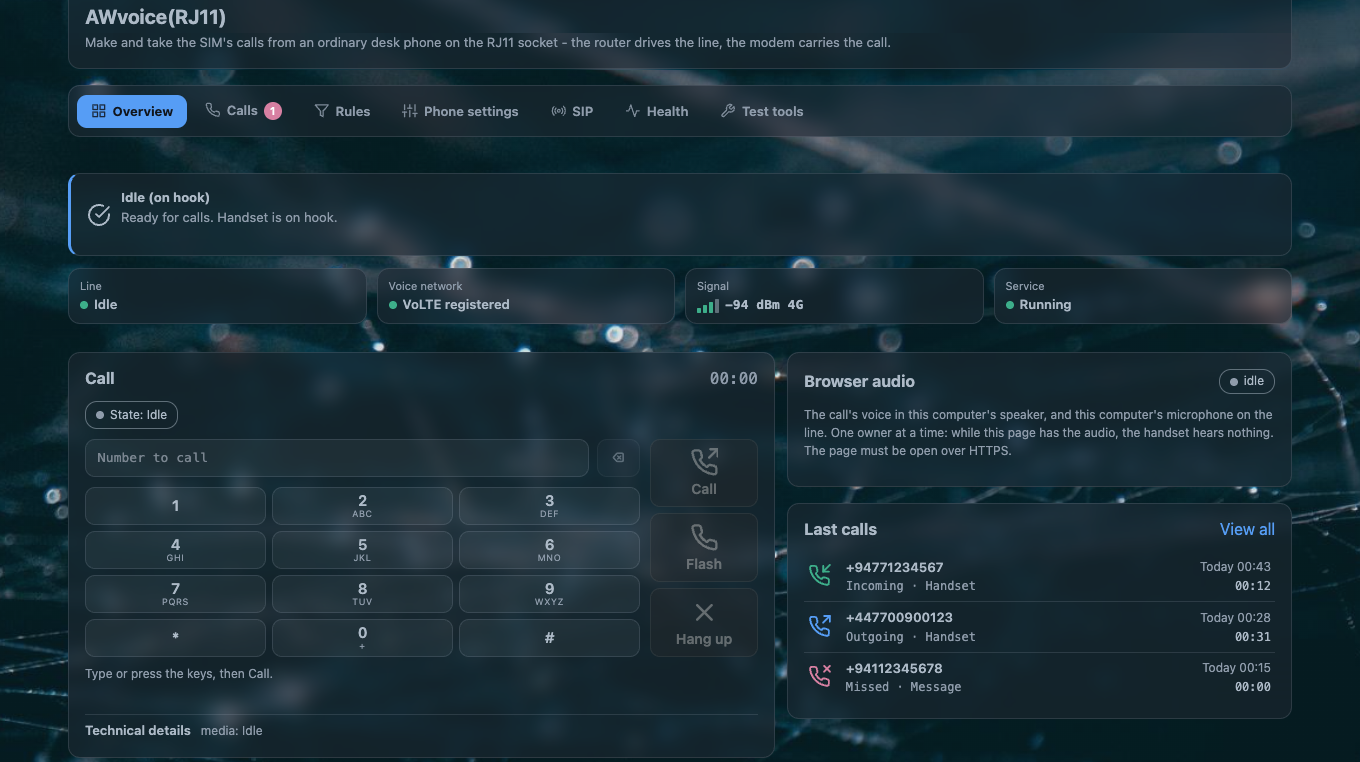
| refresh | every 1 second by default; Phone settings → Advanced → Live view refresh offers 1, 2, 3, 5, 10, 15, 30 seconds |
| deep links | the page remembers where you were: #tab=calls, #tab=sip&sip=diag, #tab=rules&rules=qh |
| the missed-call badge | on the Calls tab, and it is kept in this browser only — a second browser has its own idea of what you have seen |
| toasts | a saved message lasts 2.6 seconds |
Overview
The line, the call, and the browser phone.
| block | what it shows |
|---|---|
| the state banner | one sentence for the moment, including Call held quiet and, during quiet hours, "Quiet hours: a call from … is waiting. Answer on this page, or lift the handset." |
| four tiles | Line, Voice network (VoLTE registered / Not registered / Unknown), Signal (bars from RSRP at −90, −100 and −110 dBm), Service |
| the call card | the page's own telephone: the web phone |
| Last calls | the three newest rows, with View all into the Calls tab |
Calls
The call log: search, From date, the six filter chips with counts, Export CSV, Clear all, and one card per call with its recording or message.
The whole tab is drawn disabled when the running daemon does not answer the log method at all, so an old daemon cannot be mistaken for an empty log.
Rules
Four panes behind chips: phone book, blocking, alarm calls and quiet hours. Each list editor saves on its own OK; nothing here is a page-wide save.
Phone settings
Ten cards, in this order. Every one of them writes on Save and apply.
| card | controls |
|---|---|
| Line | Caller ID (DTMF / FSK Bellcore / FSK ETSI / Off); Caller-id timing (after or before the first ring — disabled unless the mode is one of the two FSK variants); My number; Dial pause; Hook-flash timing (two fields) |
| Tones | Ringback tone (Automatic / Always play / Never play) |
| Audio | Earpiece volume (Modem default, then 0–5); Microphone gain and Earpiece gain, both shown disabled with "Not available yet" and never written; HD voice |
| Features | Call waiting; 3-way calling; Hotline number and delay |
| Recording | Record calls; Recording folder; Storage budget; Stored recordings usage with Delete all — which settles each deletion and reports the count |
| Answering machine | Answer the phone; the Greeting card with Play, Upload WAV…, Record and the printed path /etc/awvoice/greeting.wav; Answer after; Message folder; Storage budget; Longest message; Stored messages with Delete all; and a live note that says what the machine will do |
| Speed dial | the contacts that carry a code, with Add and Remove speed dial |
| Indicator | Phone LED, built from the lamps the router actually has, plus None; Call-blink rate; Off-hook blink rate |
| Advanced | a folded card: Modem receive gain; Modem USB interface; Live view refresh |
| actions | Save and apply, then Reset (OpenWrt's own discard). Validation errors print in the tab's own line, including "Hook-flash maximum must be at least 100 ms above the minimum" and "The messages cannot be kept in the recording folder. Choose another folder." |
SIP
Two panes behind chips, Service and Diagnostics, and a mode card above them. All of it is on network phones.
| control | what it does |
|---|---|
| Mode — Who may use the phone line | the switch, with the outcome word beside it |
| Show a Linphone QR code | the provisioning code |
| Phones on this network call this router | the inbound direction: network, port, account name, password, and Create a new password |
| Calls through a SIP provider | the outbound direction: network, port, provider address, realm, account, password, re-register interval |
| Save and restart | one action, with a modal that warns "A call in progress drops while it restarts." |
| Read again | re-reads the service's settings without writing anything |
| Diagnostics | the guards, who holds the front-end name, who holds the voice port, the last refusal, the browser audio state, and the service's own files and processes |
The audio path and the RTP range are deliberately not offered here: they belong to the service, and this page does not reconfigure another program's settings.
Health
What the hardware and the operating system actually reported. Field by field on health and tests.
Test tools
Three cards, all disabled unless the line is idle:
| card | what it does |
|---|---|
| Ring test | rings the handset for 5 seconds, after a confirmation that says "Ring the handset for 5 seconds? Keep the handset on hook." |
| Line test | three samples 100 ms apart and a verdict on the line's electrical state |
| Test call | loopback, so you hear your own voice after a short delay. This build does not offer it: the card is disabled and tagged Not available yet |
What the page cannot do
| you might expect | the truth |
|---|---|
| take a call the handset is already holding | not offered. The page never interrupts a call in progress |
| change the SIP service's media socket | not offered. That file belongs to the service |
| set the microphone or earpiece gain | the fields are visible and disabled. They are not written |
| edit a call-forwarding rule | there is no forwarding pane. The network's own state is read and shown |
| see another browser's missed-call badge | the badge is per browser, on purpose |